
The Yellow Submarine
Yellow Submarine, which came out in 1969, offered an imaginative picture of a group of young people travelling below the surface of ordinary life, all aboard one ship. Paul McCartney wrote the song, and Ringo Starr’s distinctive voice brought it to life. It came from the fun yet culturally aware world of The Beatles, whose music helped shape the minds of a generation of Baby Boomers navigating the cultural revolution of the 1960s.
The song and the animated movie that accompanied it became symbols of a confident community vision. The Yellow Submarine celebrated a journey that itself is a useful metaphor: just as a car’s shock absorbers cushion the bumps in the road, a submarine is built to handle and absorb the crushing pressures of the ocean.
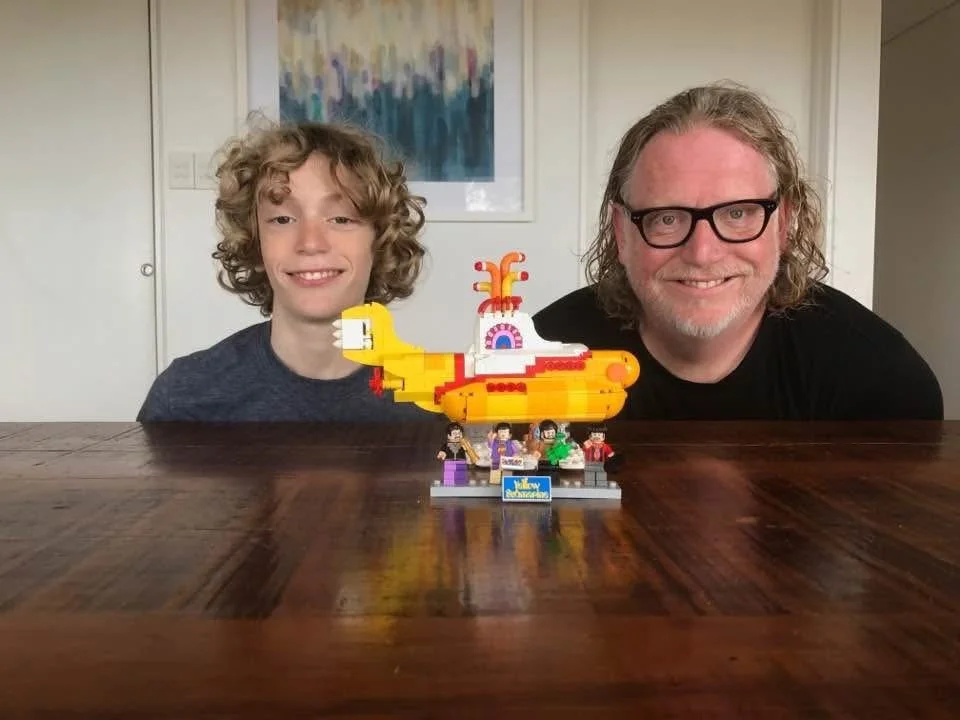
I have been a pastor for most of my life. There is nothing unusual about that. However, my pastoral work has been a little different. My own kind of Yellow Submarine. I began my ministry journey in the late 1980s as a volunteer at Gymea Anglican. Gymea is a medium-sized church in the southern beachside suburbs of the Sutherland Shire in Sydney, Australia. Together with my wife Louise, I started a small youth group at the church, which we called Soul Revival Youth Community in the early 1990s.
In many ways, the youth ministry landscape we inherited used models shaped in an earlier era—closer to the world of The Beatles’ Yellow Submarine than to the emerging realities of Generation X. While culturally intuitive in their time, these models had become institutionalised, assumed homogeneity, and had clearly defined boundaries. By the early 1990s, however, young people were inhabiting a far more diverse and sceptical cultural environment. Soul Revival emerged as an attempt to respond to this shift, not by abandoning the Gospel, but by reimagining the form of community in which it was embodied.
In my early 20s, I graduated from the University of Sydney and was accepted as a PhD candidate in Political Science at the University of New South Wales. I had been using New Social Movement Theory to study Christian youth ministry when I was invited to take on a part-time youth ministry role at Gymea Anglican. Over the next few years, Soul Revival Youth Community grew, and I decided to put my studies on hold. Again, there was nothing particularly unique in that. The unusual part was that Louise and I would end up making Soul Revival our life’s work.
The small youth group transformed into an intergenerational community that Louise and I led for the next 20 years. We did not know it back then, but under God, we were helping to design a new Yellow Submarine called Soul Revival. After leaving Gymea in 2012, I was asked by our Archbishop, Peter Jensen, and our Bishop, Peter Haywood, to plant Soul Revival Church in the Sutherland Shire suburb of Kirrawee. We planted under the leadership of Bruce Hall and Archie Poulos from the Sydney Anglican Evangelism and New Churches Department.
Not only was that a little different, but over the past seven years, I have had the privilege of restarting my PhD at the Sydney College of Divinity, returning to study the origin story of that little youth group at Gymea Anglican Church. Today, we are celebrating our 14th year of Soul Revival Church and the 34th year of Soul Revival.
My current study focuses on the bounded setting of Soul Revival Youth Community, from 1992 to 2012. In the early 1990s, Gymea Anglican Church was struggling to adapt to a changing world and was becoming increasingly irrelevant to young people. Most of the teenagers who grew up at the church left after graduating from high school. The church had little impact on unchurched youth. In 1992, we began Soul Revival as a new take on youth ministry. We attempted to adapt our ministry to Generation X as a new Grunge youth subculture emerged at the beginning of the decade.
From 1992 to 2012, Soul Revival developed distinctive practices in worship, discipleship, and community life, particularly among young people. Soul Revival responded to the increasing alienation among teenagers of Generation X and, subsequently, Generation Y, by developing new organic structures that gave youth a place in the church where they belonged and had influence.
These structures evolved into a uniquely Australian approach to youth ministry, rooted in the relational commitment of the Australian concept of mateship and inspired by Aboriginal practices of gathering for meals. We were helped in our thinking by Mark Senter III’s book The Coming Revolution in Youth Ministry, which presented modern youth ministry as a series of movements that began with the Industrial Revolution. Dietrich Bornohoffer’s Life Together and Miroslav Volf’s book Exclusion and Embrace, encouraged us to have a Christ-focused identity, belonging and purpose.
The Soul Revival leaders decided to discontinue running a youth group and instead establish a stable friendship group that would allow young people to grow in a safe and supportive environment, drawing on Ray Oldenburg’s Third Place theory of community from his book The Great Good Place. We dropped the ‘youth group’ label and replaced it with the title of ‘youth community’, as we wanted a deeper expression of the Biblical principles of loving friendship, outlined in Scriptures such as John 15:15.
These Biblical foundations led to strong, long-term, committed servant-hearted relationships between youth pastors, youth leaders, parents, elders, young adults, and the teenagers we led. We offered each other the gift of time, ‘hanging out’ and ‘having a read’(of the Bible) became the hallmarks of the approach. The mission drove the ministry as Soul Revivalists sought to love God and to share the truth and love of Jesus with everyone, everywhere, as commanded in Matthew 22:37-40. We embraced difference, not just sameness, in our all-age, all-stage community in line with Romans 12. Our early experiments blossomed into a Sutherland Shire-style intergenerational youth ministry model, which successfully provided young people with more continuity in a changing world.
I call the Shock Absorber a ‘Generative Intergenerational Model of Youth Ministry’, because it combines the generative potential of both young and adult Christians. Kenda Cressy Dean, in her book, Practising Passion: Youth and the Quest for a Passionate Church, celebrates the experimentation of young people, and Erik Erikson, in his book Childhood and Society, encourages the generative potential of adults through healthy relationships with young people. The Shock Absorber employed by the Soul Revival Youth Community at Gymea combined Dean's and Erickson's thinking into a new model. In this approach, young people generate new ideas because they are culturally flexible, while adults provide strength by drawing on Biblical wisdom and life experience. Adults listen to youth as the latter act as cultural hosts, helping the local church’s expression constantly adapt to secular society. This avoids stagnation and competition between generations in the church. Together, a combined youth and adult team can help local churches adjust to change in a positive way.
Soul Revival’s Shock Absorber led to effective discipleship and mission, transforming lives and priorities in the Gymea Youth Community. Soul Revival grew from 4 to 500 young people in 7 years, primarily through the conversion of unchurched teenagers to Christianity and their subsequent involvement in the ministry. This occurred years before Milan Nel popularised the intergenerational approach with his book, Youth Ministry: An Inclusive Missional Approach.
Soul Revival’s influence reshaped aspects of the Gymea parish. The youth ministry structures were more flexible and effective than Gymea Anglican’s pre-existing structures in reaching and retaining young people. The older strategies were influenced by the Church Growth Movement, which developed during the 1970s, and by the Homogeneous Unit Principle (HUP), which segregated age groups. The HUP was pioneered by Donald McGavern in his book, Understanding Church Growth, first published in 1970.
In contrast, the new Soul Revival structures were slightly different because they ignored age, class, race, and gender in a new Saturday-night Community that hosted intergenerational ‘relo-bashes’ (parties) and invited the whole church to community hangouts. Andrew Root, in his book, Revisiting Relational Youth Ministry: From a Strategy of Influence to a Theology of Incanation, encouraged our rejection of the HUP. We preserved additional age-appropriate junior youth spaces for youth experimentation, while also incorporating open spaces for intergenerational cooperation. We developed a ‘commitments meetings’ for Christians that became a place to share lessons from experimentation and to teach a Biblical culture of costly discipleship. This was a bottom-up and top-down approach that gave young people their own spaces to experiment, a leadership voice, and opportunities to meet with adults in intergenerational gatherings.
Looking back, Soul Revival began to feel less like a program and more like a new kind of “yellow submarine”, a community that gathered a diverse group of people and travelled together beneath the surface of conventional church life. It was colourful, relational, and at times a little unconventional, yet it created a shared world where young people could belong, explore their faith, and encounter Jesus together.
After 20 years of ministry at Gymea, the founding leaders of Soul Revival, Stu and Louise Crawshaw, left Gymea Anglican together with Matt and Lauren Redmond. Stu and Matt were subsequently invited in 2012 by Bishop Peter Haywood and Archbishop Peter Jensen to join Sydney Anglicans’ Evangelism and New Churches, where they helped establish a new Church plant, Soul Revival Church. This church plant, based on the same ‘shock absorber’ principles of generative intergenerational relationships, has had a similar trajectory to the youth group, growing to nearly 900 people from a launch team of 30 in just 13 years. We currently meet in 7 gatherings across 5 campuses.
Soul Revival’s influence reshaped aspects of the Gymea parish, and, when applied to the whole church structure at Soul Revival Church, the strategy has provided a helpful DNA and new ideas for intergenerational ministry in Sydney today. I encourage other local churches in Australia to consider adopting a generative intergenerational model so that their youth ministry can act as a shock absorber amid a changing secular culture.