
What We've Lost — Technology, Physicality and the Trade-Offs
THE SHOCK ABSORBER
Every technology gives you something. Every technology takes something away. The problem is we're usually so dazzled by what we gain that we don't notice what we've lost until it's gone.
What the Age to Come Looks Like
Tim has been writing talks on new creation for a kids camp, and the preparation has him genuinely excited — which is worth paying attention to, because the excitement comes from recovering something that a lot of Christians have quietly lost.
The popular imagination of heaven is often shaped by medieval art: clouds, harps, angels, an ethereal luminosity, the soul finally escaping the body and floating into eternity. It's the Simpsons version. It's the Sunday school flannel-board version. And it's not particularly biblical.
Our picture of new creation can be similarly distorted. Not because the underlying sources are dishonest, but because the stories have been told and retold and illustrated and reinvented until the original has been lost beneath the accumulation.
What the Bible actually describes is deeply, remarkably physical. Resurrected bodies with continuity to the ones we have now, the Jesus after resurrection still had the same face, still recognisable to his friends once the shock wore off. A renewed creation, not a replacement of creation. Paul in Romans 8 describing the creation groaning to be released from bondage — not to be destroyed, but to be liberated into its full glory.
The goal of the Christian life is not for the soul to float in heaven forever. It's for Jesus to live on a physical earth with resurrected people in a renewed creation, face to face, the way it was always meant to be. That's the future. And holding that future clearly changes how you think about the present — including how you think about the technologies that promise to liberate you from the physical.
Rallying and the Unwrapped CD
Joel had been watching a Hyundai rally video — the sights, the sound, the smell of rubber and gravel that he can recall from attending rally events years ago — and it had unexpectedly recaptured everything he'd let drift away. The sensory memory was vivid and irreducible. You can't stream it. You can't reproduce it. It was the thing itself.
And it connected to a broader question he'd been sitting with: what do we lose when technologies remove us from the physical? The dishwasher saves hours but ends the shared experience of the family at the sink, debriefing the day as someone washes, someone dries, someone puts away. The car expands our reach dramatically but means the people in your church might live 40 minutes away from each other, and the sense of geographic embeddedness, of community formed by place, quietly dissolves.
Tim's version of this is unwrapping a CD. The knife in the sticker on the edge of the case. The jewel case hinge clicking open. The lyric book. The inside artwork. The whole designed artefact of a physical album — all of it lost to the Spotify scroll. He can still access more music now than he ever could have owned. But something went with it too.
Mike Dicker's Framework
Mike Dicker, principal of YouthWorks College, has written a helpful article that gives this conversation a practical grid. Drawing on Marshall McLuhan, Andy Crouch and John Dyer, he sets up four questions that every new technology answers simultaneously.
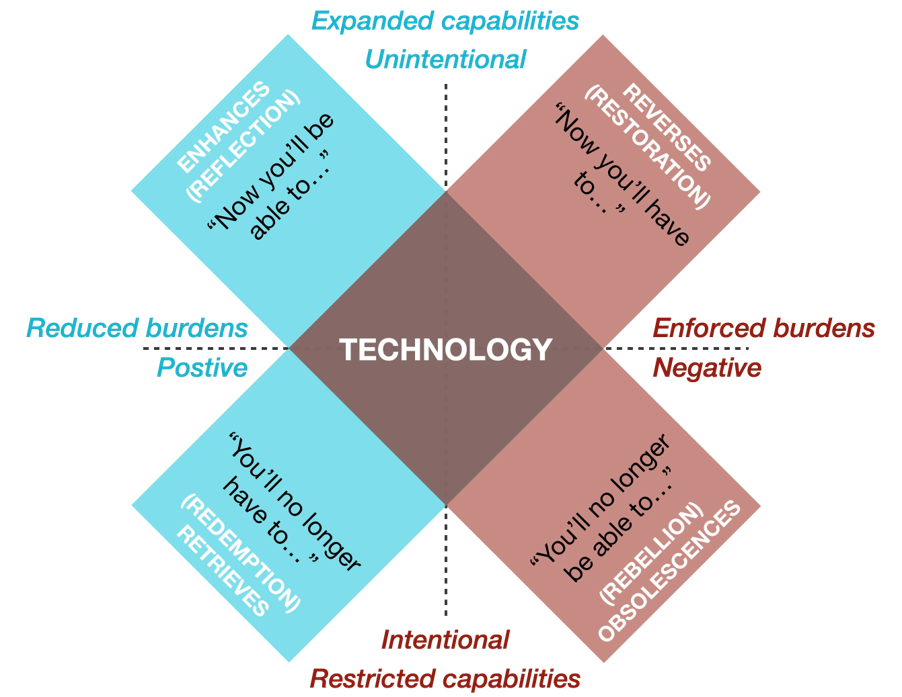
What does it enhance?
What new capability does it give you? What new thing can you do? Spotify gives you access to more music than you could ever own. The microwave means you don't have to eat dinner together. Zoom means you can have meetings without leaving your desk.
What does it make obsolete?
What can you no longer do, or do naturally, because of this? Spotify means you no longer have the album as a coherent artefact. The microwave means you no longer have to synchronize the family around meal preparation. Zoom means you no longer have the thirty-minute drive between meetings.
What does it retrieve?
What had previously been lost that this technology brings back? Spotify retrieved access to music that was economically out of reach — the back catalog of artists you could only afford in singles. Zoom retrieved the ability to connect with someone interstate without the cost and time of travel.
What does it reverse into?
What does it become when pushed to its extreme? Spotify reversed into an algorithmic feed where you're no longer choosing what you hear — the platform is choosing for you. The microwave reversed into a household where the shared meal disappeared. Zoom reversed into a schedule so packed with consecutive calls that people were more exhausted than they'd ever been in person.
Every technology pulls in all four directions at once. The wisdom is in seeing the whole picture.
The Zoom Fatigue Nobody Could Explain
The COVID lockdowns produced a natural experiment in the limits of digital presence. The first instinct was relief: no commute, no buffer time between meetings, no driving across the city, no expensive coffees. Just back-to-back calls from home, in comfortable clothes, with full productivity.
And after a couple of weeks, everyone was wrecked. Nobody could understand why. They were doing less physical work. They were at home. They had unlimited access to their own kitchen. Why were they so exhausted?
The answer, in retrospect, is obvious. In-person communication is a full-body experience. You're reading body language, facial expressions, posture, micro-expressions — all of it below the level of conscious processing. You're also, stranger but real, exchanging pheromones. Your hormonal system is reading the other person in ways that can't be replicated on a screen. The mental work of an in-person conversation is distributed across multiple systems; the mental work of a video call is concentrated in the parts of your brain doing the work of compensating for everything that isn't there.
The thirty-minute drive between meetings wasn't wasted time. It was a neurological reset between conversations. The movement of getting in a car, finding a park, walking across a car park — all of it giving the brain the space to process what had just happened and prepare for what was next.
The technology gave: efficiency, accessibility, cost savings. The technology took: the physical presence, the distributed sensory communication, the embodied transitions between encounters. The net result was exhaustion without a name for itself.
Presence
Alan Noble’s argument in his piece Presence in an Age of AI Reproduction is that one thing a machine will never be able to offer is presence. Behind a wedding vow written by ChatGPT, there is no “I who says I do”. Behind the pop punk breakup song generated by AI, there is no teenage experience of being dumped. There is only output. What a human being can offer that a machine never can is presence: the intentionality of a person who decided to make this thing for you.
Yann Martel, author of Life of Pi, makes the same point. He'd rather read a bad short story by a human than a good one by a computer. Because what he's looking for in a story isn't just competent prose or an interesting plot. He's looking for connection with another human being. The quality of the work matters; but whether there's a person behind it matters more.
This connects directly to the theology of creation. God made human beings as embodied, relational, personal beings, made in the image of a God who is himself personal and relational. The physicality isn't the problem. The body isn't the part that's going to be discarded. The age to come is not the soul escaping to a spiritual realm. It's the person, the full, physical, embodied person, living in renewed creation with the God who made them.
When technologies nudge us toward less physicality, less presence, less of the embodied in-person encounter — when we trade the person for the output — we're trading away something that is actually us. Not a bug in our design. The design itself.
The Trade-Offs We're Still Working Out
None of this is an argument for technological refusal. Tim still uses Spotify. He's genuinely glad he has a washing machine. The drive time between meetings really was sometimes wasteful. The question is not whether to use technology but whether you're seeing both sides of what you're trading.
Joel's son has started resisting AI for his assignments. Not because he's been told to, but because something in him recognises that getting the AI to answer the question isn't the same as him answering the question. The synthesis, the struggle, the working-it-out, these are part of the point. They're forming something in him that the output, however polished, cannot replicate.
The Shock absorber framework gets the final word. The youngest generations are at the forefront of technological change — they're living in a world where AI summaries are the first thing on a Google results page and where Spotify is the only music delivery system most of them have ever known. There's genuine wisdom in watching how they navigate it, what they find useful, what they reach for.
And the maturity of older generations, the people who remember what CDs felt like and what the family dinner table was for, has something to offer too. Not as a veto on change but as a perspective on what's being traded. Holding those two together, the vitality of the young and the wisdom of experience, is exactly what the shock absorber is designed to do.
The Middle Ground
Somewhere between typing out your bibliography by hand and asking ChatGPT to write your essay for you is a wise use of a reference management system that saves the mechanical work so you can focus on the intellectual work.
Somewhere between refusing the washing machine and dispersing the family after dinner is a household where the machine does the washing and the family still finds a way to talk.
Somewhere between cassette tape loyalty and algorithmic surrender is a person who uses Spotify to access the back catalog they always wanted but curates their own feed and knows why they're listening to what they're listening to.
Theology first. Strategy second. Practice third. Start with who we are: embodied, relational, made for presence and physicality and connection with other persons, and then work out what technologies serve that and what technologies erode it.
What have we traded? It's worth asking. It's worth knowing the answer.
Discussed on this episode
Mike Dicker — Navigating Technology
Alan Noble — Presence in an Age of AI Reproduction
Andy Crouch — The Tech-Wise Family
Andy Crouch — Culture Making
John Dyer — From the Garden to the City
Yann Martel on the How I Write Podcast
Alan Noble — Disruptive Witness
Listen to the full conversation on the Shock Absorber podcast.
The Shock Absorber is a podcast for church leaders doing church a little differently. Next episode: the tangibles of church project management. Subscribe so you don't miss it. Email Joel at joel@shockabsorber.com.au, and join the Shock Absorber Network at shockabsorber.com.au.
For more on theology, strategy, and practice in ministry, subscribe wherever you get your podcasts or email joel@shockabsorber.com.
Soul Revival Church is an Anglican church in the Sutherland Shire and Ryde.